Sequencing vs. Suppression: Why the Order of Treatment Determines the Outcome
Why treatment sequence matters more than treatment intensity — and why most approaches begin at the wrong layer.
HS does not recur randomly. It recurs because the internal conditions that create it — inflammatory load, gut dysfunction, hormonal imbalance, immune dysregulation — have not been addressed. The EPOH HS Protocol™ is built around correcting those conditions, in sequence, at the right depth.
A structured 5-phase system — from inflammation to remission
Removing the triggers sustaining internal inflammation before any repair can begin.
→ Reduced flare frequencyCorrecting gut dysfunction and microbiome imbalance that drives sustained immune activation.
→ Stabilised gut & immune responseClearing accumulated inflammatory load and recalibrating immune response patterns.
→ Inflammatory load clearedTargeted wound care, scar management, and local tissue correction — done at the right stage.
→ Active lesion managementBuilding the long-term internal resilience that prevents recurrence from restarting the cycle.
→ Long-term stability & resilienceMost HS patients have already tried several treatments. Antibiotics. Steroids. In some cases, surgery. And yet — the condition returns. Understanding why this happens is the first step toward a different outcome.
"Unless the underlying causes are addressed, the condition may continue to recur despite treatment — regardless of how aggressively individual lesions are managed."
HS does not fail treatment. Treatment fails HS — when the approach is incomplete. After treating hundreds of patients, these are the seven consistent patterns that delay recovery or cause the condition to worsen. The EPOH Protocol is structured specifically to address each one.
Misdiagnosis — the lost years
HS goes unnamed for an average of 7–10 years. The disease progresses quietly while the patient receives treatment for the wrong condition. By the time a correct diagnosis arrives, the body has learned to flare repeatedly.
Treating flares, not patterns
Each lesion is treated as an isolated event — drained, medicated, monitored. The cycle that produces it continues untouched. Flares are the final step of the disease process, not the first. Addressing the output without interrupting the process guarantees recurrence.
Wrong medicine at the wrong time
Detox during active inflammation. Biologics before metabolic load is reduced. Local wound care before internal correction. In HS, timing matters as much as the intervention itself. One wrong step in the sequence destabilises the entire treatment arc.
Ignoring gut health and metabolism
The gut is not peripheral to HS — it is central to it. Digestive imbalance, food sensitivities, bloating, and sluggish metabolism are present in the majority of moderate-to-severe cases. Correcting the gut changes the inflammatory environment. Ignoring it makes stable remission structurally impossible.
Wrong or absent diet guidance
Diet is not a supporting factor in HS — it is a primary driver. Some practitioners dismiss it entirely; others prescribe rigid protocols without understanding individual metabolic patterns. What works is identifying the patient's specific trigger foods and building an anti-inflammatory eating structure around their profile.
Underestimating the stress–inflammation link
Stress in HS is not a soft factor — it is a biological one. A single day of significant emotional stress can elevate inflammatory markers for 48–72 hours. Cortisol dysregulation worsens gut permeability, insulin resistance, and immune calibration simultaneously. Psychological stability is a clinical requirement for remission, not an optional wellness addition.
No long-term plan — only short-term survival
Most treatment models end when the flare settles. HS does not. Without a relapse-prevention structure — seasonal adjustment, metabolic maintenance, scar management, stress regulation — patients cycle endlessly between flare and frustration. A chronic disease requires a chronic strategy, not repeated acute responses.
The Protocol is not a collection of treatments. It is a sequenced clinical system — each phase builds the conditions necessary for the next. The order is deliberate. Skipping phases, or beginning at the wrong stage, is why most non-systemic approaches do not hold.
How this protocol developed
The EPOH HS Protocol™ did not begin as a five-phase system. It started as a three-phase model and deepened through years of clinical observation — each refinement driven by cases that did not respond as expected and demanded a closer look at what was being missed, and in what order. The sequence presented here is not theoretical. It reflects what consistently failed when steps were skipped, and what changed when they were not.
Ayurveda provides the diagnostic lens — Pitta, Vata, and Kapha together explain why HS is not a single-system disease, and why each phase of the Protocol addresses a different layer of this tridoshic imbalance.
Ayurvedic Foundation of the EPOH Protocol™
| Protocol Phase | Clinical Focus | Ayurvedic Parallel |
|---|---|---|
| Phase 1 — L | Reduce inflammatory load | Pitta pacification · Ama reduction |
| Phase 2 — I | Gut & metabolic repair | Agni restoration · Srotas healing |
| Phase 3 — F | Detox & immune rebalancing | Rakta Shodhana · Srotorodha clearance |
| Phase 4 — E | External tissue healing | Dhatu repair · Vrana Ropana |
| Phase 5 — S | Sustained remission | Rasayana · Ojas strengthening |
Before any healing protocol can take effect, the internal environment sustaining inflammation must change. Phase 1 is not about treating HS directly — it is about removing the conditions that keep it active. This means addressing dietary triggers, identifying personal flare drivers, and resetting the metabolic and immune signals that are continuously fuelling the inflammatory cycle.
In many HS patients, the gut is not a secondary consideration — it is a central driver. Gut dysfunction creates a condition where the immune system receives a continuous signal of internal threat. This activates and sustains the inflammatory response that eventually expresses through the skin. Correcting this connection is not optional in chronic or recurring HS — it is foundational.
Phase 3 is not aggressive detoxification. In HS — particularly in moderate-to-severe presentations — aggressive purging can destabilise an already dysregulated immune system. This phase uses structured, gentle protocols designed to clear accumulated inflammatory load from tissues and channels, while simultaneously recalibrating immune response patterns that have become misfiring or hypersensitive.
External care is meaningful only after the internal inflammatory environment has been brought under control. Applied to actively inflamed tissue without internal correction, even sophisticated topical or local interventions are fighting against the body's own sustained immune response. In the EPOH Protocol, Phase 4 arrives when the internal phases have created the biological conditions for local healing to be sustained.
Reaching remission is not the same as sustaining it. Many patients achieve significant improvement only to experience a relapse months later — often triggered by stress, hormonal shifts, dietary regression, or seasonal changes. Phase 5 is designed specifically to prevent that pattern by strengthening the patient's internal resilience, recalibrating stress-hormone cycles, and establishing routines that support long-term biological stability.
The identity dimension of Phase 5
As physical symptoms reduce, something else begins. Many patients who have carried HS for years realise the condition left marks beyond the skin — on how they see themselves, how they move through social situations, which clothes they allowed themselves to wear. Phase 5 is where these begin to reverse as well.
Patients move through three recognisable stages: an initial phase of relief mixed with disbelief ("is this real?"), followed by a period of confronting what the years of HS actually cost — grief, frustration, lost relationships, missed events — and finally a gradual rebuilding of confidence, social participation, and physical freedom. This arc is not incidental to treatment. Emotional stability supports biological stability: patients who process this dimension relapse less often and maintain routines more consistently.
In the EPOH framework, this is the phase of Rasayana —
where long-term stability is rebuilt.
Not merely preventing relapse,
but restoring Ojas —
the body's core resilience, clarity, and capacity.
It is the difference between being in remission and being well.
A Note of Clarity
Remission in HS does not always mean complete absence of lesions.
It means the disease no longer controls your daily life.
For many long-standing cases, this is a clinically meaningful and achievable outcome.
Treatment is monitored on a structured basis throughout all five phases — symptom inputs, phase transitions, and clinical response are tracked, allowing early course correction before problems compound.
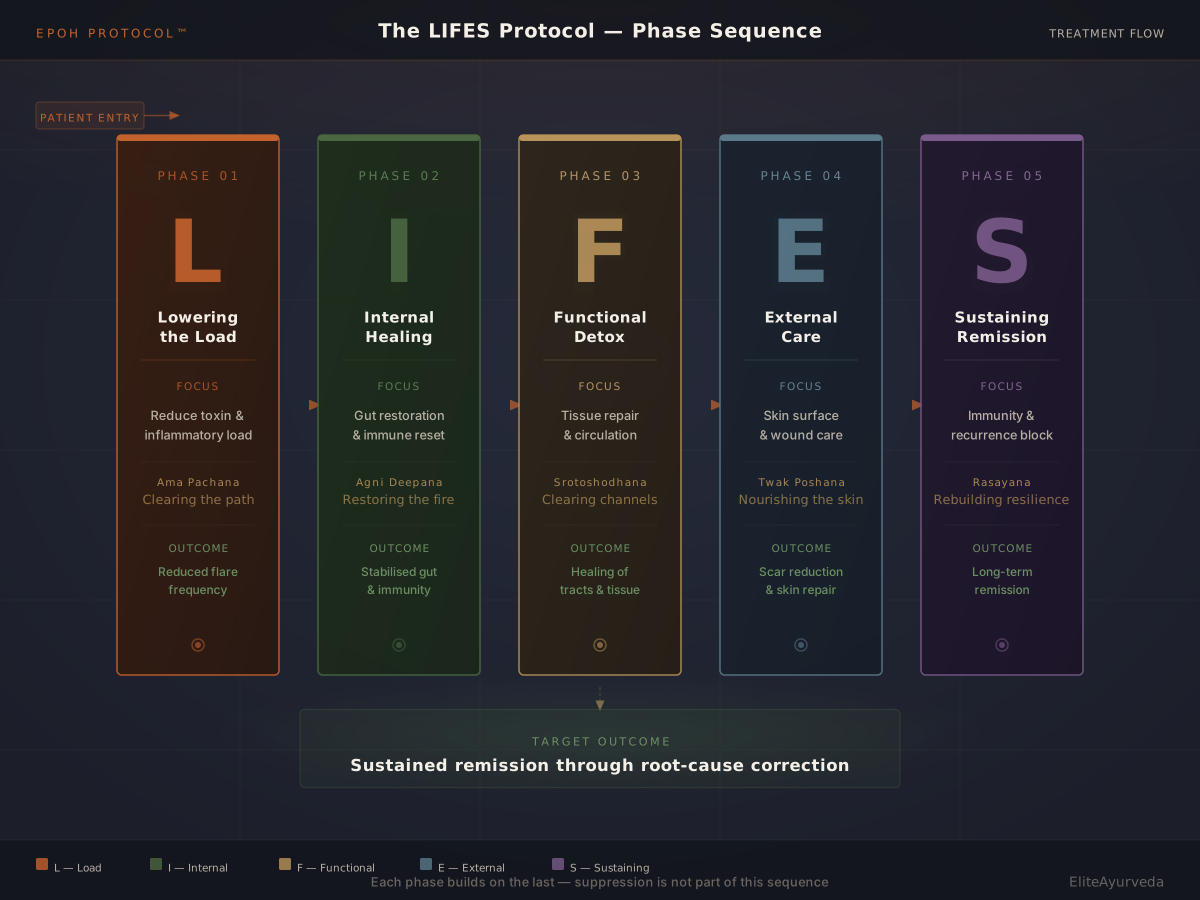
The EPOH HS Protocol™ — five-phase flow from inflammatory load reduction to sustained remission
There is no fixed formulation for HS. What is described below represents the six functional categories used across the protocol. The specific composition — which categories are used, in what proportion, and at what phase — is determined through individual evaluation. No two patients receive the same formulation.
No specific herbs are listed here intentionally. Personalised formulations are determined through clinical evaluation — not prescribed from a fixed protocol.
These are not failures of motivation or effort. They are patterns seen repeatedly in patients who have been through multiple treatment cycles without lasting relief. Each represents a clinical error — often systematic — that any new approach must correct.
HS is misdiagnosed as folliculitis, furunculosis, or simple boils — sometimes for a decade. During this time, lesions progress and the internal inflammatory burden deepens, making later correction more difficult.
Treating each lesion as a separate event — rather than as an expression of a continuous systemic process — ensures that new lesions will keep forming. The target must be the internal environment, not the visible output.
Diet is not a peripheral consideration in HS. Certain patterns of eating directly elevate the internal inflammatory load. Continuing to eat in ways that sustain inflammation undermines every other treatment being applied simultaneously.
Aggressive detox or deep systemic intervention applied to a patient in active flare, or before the gut has been stabilised, can worsen immune dysregulation. Sequencing is clinical intelligence — not just a preference.
The blood-level inflammatory environment in HS is often significantly elevated — even between visible flares. Addressing only the skin while this systemic inflammation continues means the condition always has the internal fuel it needs.
Incorrect wound care — particularly in draining sinuses or post-surgical sites — can introduce secondary infection, delay healing, and generate new inflammatory signals that feed the overall cycle.
Stress hormones directly affect immune function and inflammatory signalling. HS patients who have lived with the condition for years often carry a level of chronic psychological stress that actively worsens the biological pattern. This is not secondary — it is part of the clinical picture.
This is not a promise of a specific timeline. HS progression and recovery are individual — influenced by disease stage, duration, systemic burden, and patient-specific factors. What follows is the clinical pattern most commonly observed across phases.
Flare frequency may not drop immediately — but flare intensity often does. Gut symptoms improve. Energy stabilises. Hormonal patterns begin to normalise. This is the phase where the inflammatory foundation is being dismantled.
Existing lesions begin healing rather than expanding. New lesion formation slows. Draining sinuses show reduced output. Scar tissue softens in some patients. The skin's local environment responds to the internal correction underway.
Lesion-free intervals lengthen. Remaining activity becomes manageable. The patient is able to maintain remission without ongoing dependence on suppressive interventions. Sustained remission — not just temporary relief.
"When a condition keeps recurring, it usually follows an underlying pattern that needs to be understood and addressed — not suppressed."
This is a structured, time-intensive, personalised clinical process. It requires patient commitment and realistic expectations. Not every patient in every situation is an appropriate candidate.
The best way to determine suitability is through a structured evaluation — a clinical conversation about your specific pattern of HS, history, and current situation. This evaluation is not a sales process. It is an honest assessment of whether this approach matches your condition.
Dr. Adil Moulanchikkal, BAMS — Founder, EPOH
The EPOH HS Protocol™ was developed through direct clinical observation of patient patterns — not from a textbook. 15+ years of practice, 300+ HS cases in remission.
EPOH · Dr. Adil Moulanchikkal, BAMS · +91 88847 22246 · Personalised evaluation required before treatment commences
Why treatment sequence matters more than treatment intensity — and why most approaches begin at the wrong layer.
The mechanism by which gut dysfunction translates into repeated skin lesions — the gut–skin axis in HS.
Honest framing of what remission in HS looks like, what it requires, and what realistic expectations involve.