The EPOH HS Protocol™ — Full Explanation
The complete clinical rationale behind the 5-phase framework — why each phase exists, what it addresses, and how the sequence produces lasting results.
If the lesion keeps returning, the problem has not been addressed — only managed.
Most HS treatments manage what is visible. At EPOH, treatment begins at the internal imbalance that makes the skin behave the way it does — gut, hormones, immunity, metabolism.
"The goal is not just to control symptoms, but to understand why the condition is occurring in the first place."
— Dr. Adil Moulanchikkal, BAMS · EPOH
300 HS cases in remission with the EPOH HS Protocol
Treatment at a Glance
Phase-based & sequential
Each phase builds on the previous. Sequence matters.
Personalised to your pattern
No two HS cases are identical. Treatment follows your drivers.
Internal correction first
Gut, hormones, immunity — addressed before the skin.
Built for sustained remission
Not a temporary fix. The aim is a stable, non-recurring state.
A personalised evaluation is required before treatment begins. This ensures the protocol addresses your specific pattern.
Start a ConversationUnderstanding why previous treatments have not provided lasting relief is not a criticism of care received — it reflects a genuine structural limitation in how HS has traditionally been approached. Each treatment layer has a role, but none reaches the root of recurrence.
Antibiotics reduce bacterial load and dampen inflammation temporarily. They are a useful acute tool. Over time, however, repeated courses disrupt gut microbiome balance — which is itself a key driver of HS in many patients. The internal environment is not improved; it is often worsened.
Result: Temporary reduction, followed by recurrence often at greater intensity.
These agents suppress immune signalling — reducing inflammatory activity in the short term. They do not correct why the immune system is misfiring. The underlying triggers (gut imbalance, hormonal dysregulation, metabolic dysfunction) remain active. When suppression is withdrawn, the condition reasserts itself.
Result: Control maintained only while suppression continues. Root cause untouched.
Surgical excision removes existing lesions, tunnels, and scar tissue. It is sometimes appropriate in advanced structural cases. What it cannot do is alter the systemic environment that produced those lesions. Without internal correction, the same processes that caused the first set of lesions continue.
Result: New lesions form — often in adjacent areas. Recurrence rates after surgery remain high.
"If your HS keeps coming back despite treatment, it usually means the root cause has not been addressed — not that the condition is untreatable."
There is a structured, sequential path from recurrence to remission.
See the EPOH ApproachThe EPOH HS Protocol™ is structured as five sequential phases. Each phase has a specific biological role. The sequence is intentional — attempting to reach later phases without completing earlier ones produces incomplete results.
Chronic HS patients carry a sustained inflammatory load — accumulated over years of unresolved internal triggers. This inflammation does not reset between flares; it compounds. Phase L addresses this accumulation directly, lowering the baseline inflammatory state so that subsequent healing phases can function.
From an Ayurvedic perspective, this corresponds to the reduction of Ama — the accumulated toxic metabolic load — that sustains the inflammatory cycle. Without clearing this load, deeper correction remains inaccessible.
Typical Duration
4–8 weeks, varying by disease duration and baseline inflammatory state
In the majority of HS patients, gut dysfunction is not a secondary consideration — it is a primary driver. When the gut barrier is compromised, inflammatory signals leak into circulation continuously, keeping the immune system in a state of chronic activation. Skin lesions are, in part, this activation expressing at the tissue level.
Phase I focuses on restoring gut integrity and rebalancing immune signalling. This phase also addresses hormonal imbalances where present — particularly in women with PCOS-linked or cyclical HS — since hormonal patterns directly influence flare frequency and intensity.
Typical Duration
8–16 weeks; longer in cases with complex hormonal or metabolic involvement
Long-standing HS involves not only surface lesions but deeper tissue involvement — compromised lymphatic flow, fibrotic change, and accumulated inflammatory residue in subcutaneous layers. Phase F addresses this structural layer through formulations and supportive interventions that clear accumulated toxin load from deeper channels.
This phase targets what persists even after systemic inflammation has lowered — the residual tissue dysfunction that predisposes areas to repeated lesion formation. In Ayurvedic terms, this is Srotorodha: blockage of internal channels that prevents the body from self-clearing effectively.
Why detox must be gentle — and why sequence matters
Detoxification applied before internal inflammation has reduced and gut function has stabilised mobilises accumulated toxins faster than the compromised system can process them — worsening rather than improving the condition. This is why Phase 3 follows Phases 1 and 2, not precedes them. It is not generic cleansing; it is targeted removal of a specific accumulated load, at the point when the body can actually clear it. Patients who have tried aggressive "detox" approaches earlier and experienced worsening should understand this: the problem was timing, not the principle.
Typical Duration
6–12 weeks; concurrent with Phase I in many patients
With internal correction underway, Phase E focuses on the skin itself — accelerating repair of active lesions, supporting healing of sinus tracts, reducing scarring, and restoring tissue integrity in affected areas. This phase works because internal conditions have shifted; external care applied without internal correction produces limited and temporary results.
External formulations are personalised to lesion type, location, and stage. Management of friction, heat, and moisture in affected areas is also structured during this phase.
Typical Duration
Ongoing through Phase I–F; intensified as internal correction takes effect
Remission is not the absence of active lesions — it is the stable internal state that makes recurrence unlikely. Phase S is the longest phase and, in many ways, the most important: it is where the gains made in Phases L through E are consolidated and made durable.
This phase includes ongoing monitoring, lifestyle integration, formulation tapering, and strengthening of immune resilience. Many patients reach Phase S and find that, for the first time in years, they are not planning around their next flare.
Duration
Ongoing maintenance; active monitoring for 6–12 months post-stabilisation
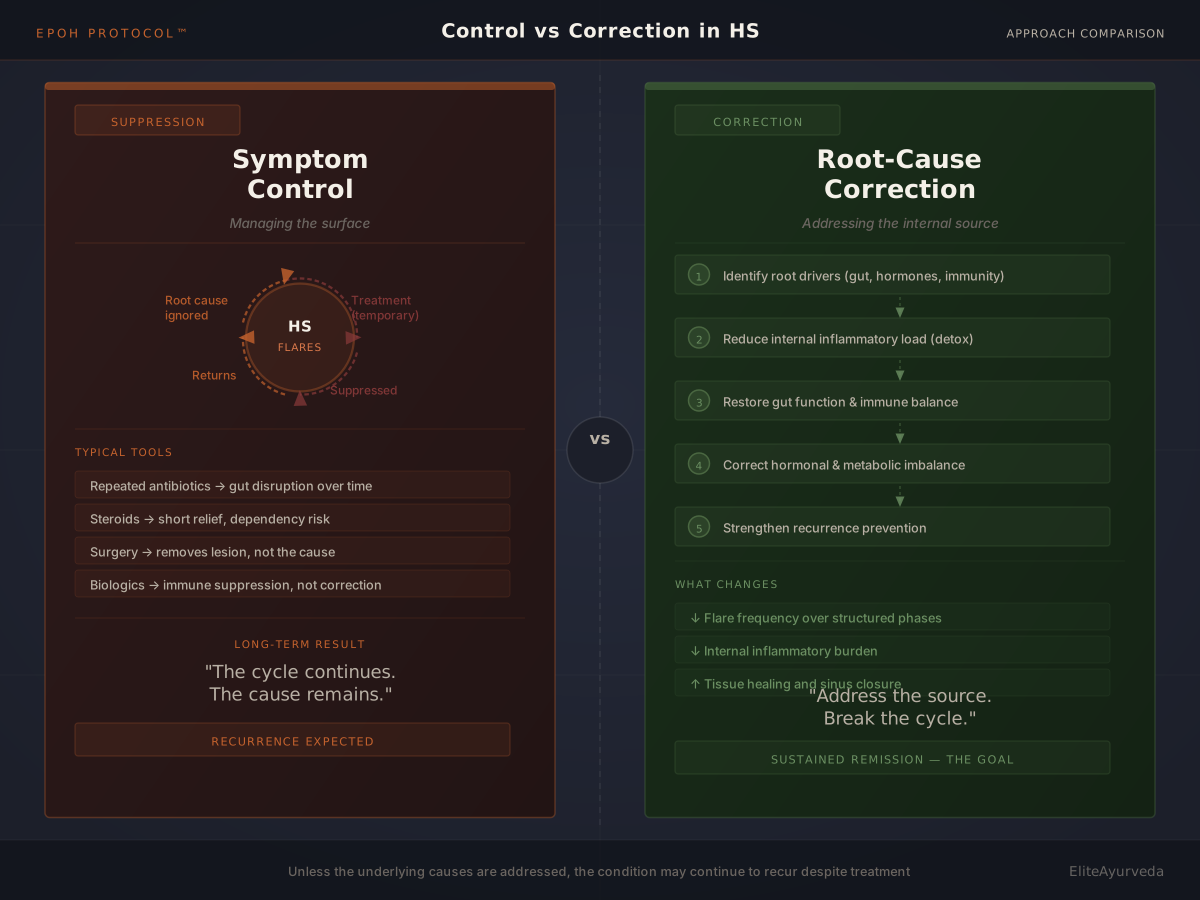
Control vs correction — why suppression-based treatment differs from root-cause resolution
Each formulation is built from Ayurvedic classical medicine — adapted to the patient's specific doshic pattern, disease stage, and gut status. No two formulations are identical because no two presentations of HS are identical.
Personalised Ayurvedic Formulation System — EPOH
Every patient at EPOH receives formulations developed specifically for their pattern of HS — their disease stage, dominant triggers, hormonal profile, and gut status. There are no standard combinations. The formulation system works in five functional categories:
Reduces accumulated inflammatory load and supports the body's ability to clear toxins from circulation. Addresses blood-level imbalance that sustains skin lesion formation.
Promotes healing of active nodules, draining lesions, and sinus tracts. Supports collagen and tissue integrity in historically affected areas. Both oral and topical formulations where appropriate.
Targets androgen excess, PCOS-related patterns, and insulin resistance where these are identified as drivers. Particularly important in women with cyclical flare patterns.
Restores digestive function and gut barrier integrity. Addresses the microbiome disruption often caused by repeated antibiotic courses. Reduces the internal toxin production that sustains chronic inflammation.
Strengthens long-term immune resilience and systemic stability. Used in Phase S to maintain the internal environment achieved through earlier phases. Prevention, not maintenance suppression.
Formulations are compounded based on your clinical assessment — not selected from a menu. The ratio, combination, and administration method of each formulation is determined by your specific imbalance pattern, disease stage, and response at each phase.
Honesty about timelines is not a weakness — it is a clinical requirement. HS that has been active for years does not resolve in weeks. Here is what the corrective process typically looks like.
The initial period focuses on reducing inflammatory load and beginning gut correction. New flares may still occur during this phase. This is expected — the system is clearing, not worsening. Most patients notice subtle shifts: slightly less intensity per flare, somewhat longer gaps between them.
The partial improvement plateau
Many patients reach a point — often in weeks 3–6 — where inflammation reduces but they feel stuck. Flares are less severe but still recurring. Digestion is better but unpredictable. This plateau is the hallmark signal that Phase 1 has done its work and Phase 2 (internal healing) needs to begin. It is not a sign that treatment has stopped working — it is the transition point between clearing the environment and rebuilding it.
As internal correction progresses, the pattern typically shifts: flares become less frequent, shorter in duration, and less severe. Active lesions begin to resolve more completely between cycles. This period is where most patients first feel that something is genuinely different from prior treatments.
With internal imbalance progressively corrected, longer flare-free periods emerge. Tissue healing in previously affected areas becomes more visible. Hormonal patterns stabilise for women with cyclical HS. The goal shifts from managing flares to maintaining a stable internal state.
Stable remission — defined not as perfect skin but as a non-recurring, manageable baseline — becomes the focus. Treatment continues at a maintenance level, building resilience and monitoring for trigger reactivation. Results at this stage vary by disease duration, but the aim is a life not structured around the next flare.
An Honest Note
Not every patient responds equally. Disease duration, degree of organ involvement, and remaining biological repair capacity all influence outcomes. Some patients — particularly those with very advanced fibrotic HS or irreversible organ damage — may not achieve full remission.
A personalised evaluation is the only way to assess your specific response potential. We do not over-promise. We explain clearly what correction looks like for your pattern.
Structured monitoring throughout
Treatment is monitored on a structured basis — symptom inputs, phase transitions, and clinical response are tracked throughout, allowing early course correction before problems compound.
What Makes Cases Respond
Remaining gut repair capacity
Hormonal patterns that can be rebalanced
Disease duration under 10 years (though longer cases do respond)
Commitment to the full protocol duration
Limited prior antibiotic history — fewer courses means less compounded microbiome disruption to correct
Predominantly inflammatory rather than fibrotic disease — active inflammation can be modulated; established fibrosis sets a structural ceiling
Emotional resilience and capacity to engage with lifestyle change — psychological stability is a biological factor in treatment response, not a soft one
The clinical markers of HS improvement are measurable — reduced flare frequency, decreased drainage, improved gut function, stabilising hormonal patterns. What is harder to measure, but equally real, is what shifts in daily life as the internal conditions change.
Phase 2 — as gut corrects
Energy improves. Morning heaviness reduces. Mood stabilises. Brain fog lifts. These are not incidental — they are downstream effects of gut correction that the books document consistently across patients. Digestion improving is felt before it is measured.
Phases 3–4 — as lesions reduce
The anticipatory anxiety around the next flare begins to dissolve. Patients stop planning their lives around potential eruptions. Clothing choices change. Posture improves — there is no longer something to guard. Sleep deepens. Social participation returns gradually.
Phase 5 — as remission stabilises
What HS had displaced — travel, exercise, intimacy, professional confidence — begins to return. Many patients report that Phase 5 is the first time they have felt that their body is with them rather than working against them. Emotional stability at this stage is itself a biological protective factor against relapse.
"My skin is healing, but so am I." — this is among the most consistent things patients say when asked what has changed. The physical and the personal are not separate in HS. Treatment that addresses only one produces incomplete results.
| Aspect | Conventional Approach | EPOH Approach |
|---|---|---|
| Primary target | Surface lesion, bacterial load, inflammatory signalling | Internal imbalance driving lesion formation — gut, hormones, immunity |
| Treatment model | Management — keep symptoms under control | Correction — address and resolve underlying drivers |
| Personalisation | Protocol-based (same antibiotic course for most patients) | Pattern-matched to individual driver profile |
| Recurrence logic | Managed as expected feature of the disease | Recurrence indicates unresolved root cause — addressed directly |
| Gut health | Not typically addressed (antibiotics often worsen it) | Central treatment priority; gut is often the primary driver |
| Hormonal factors | Addressed separately, if at all (hormonal pills) | Integrated into treatment — especially for women with PCOS-linked HS |
| Long-term aim | Minimise flare frequency; maintain control | Stable internal state where flares no longer occur |
EPOH · Dr. Adil Moulanchikkal, BAMS · +91 88847 22246 · Personalised evaluation required before treatment commences
The complete clinical rationale behind the 5-phase framework — why each phase exists, what it addresses, and how the sequence produces lasting results.
Why the sequence of treatment matters more than treatment intensity — and why most approaches begin at the wrong layer.
What HS actually is, why it develops, why it keeps coming back — and what the disease looks like at each stage of progression.